
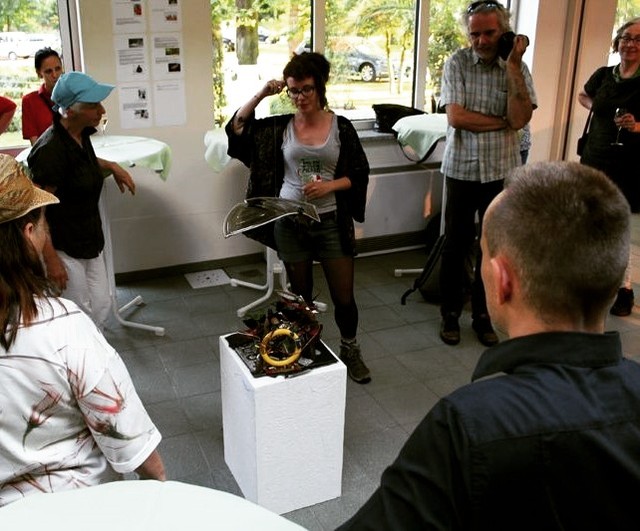
Project Thinking bridges – Art bridges 2017, artist talk,
Zeynep Özkazanc talks about her installation
Place: Orangery in the East German Rose Garden, Forst (Lausitz)
curators Margret Holz, Andrzej Rasczyk, Project Management Margret Holz
With
Laure Catugier FR, Varda Getzow IL-DE, Grazyna Jaskierska PL
Zeynep Özkazanç TR-DE, Kirsten Kötter DE, beate maria wörz DE
Deborah S. Phillips DE, Janusz Orzepowski PL, Wojtek Skowron PL
Lukaz Samsonowicz PL, Manfred Gebhardt DE.
Photo: MFG © VG Bild Kunst
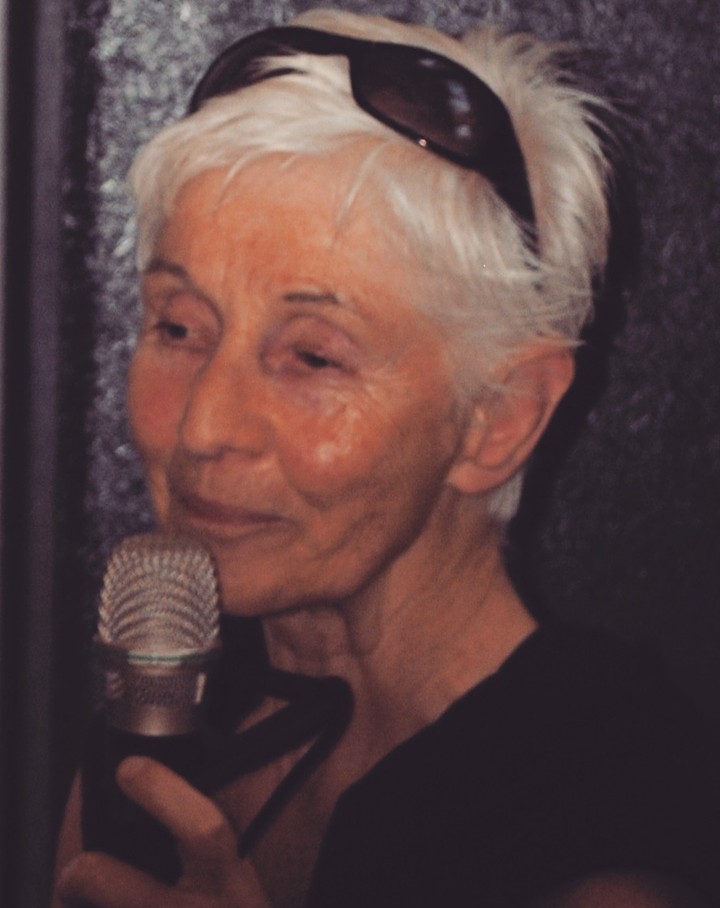
Margret Holz opens the exhibition, July 9 – September 30, 2017, Photo: MFG © VG Bild Kunst
“Thinking Bridges – Art Bridges” Symposium and Exhibition with 10 artists and one guest at the Visitor Center of the East German Rose Garden Forst (Lusatia) 07/08-09/30/2017 The symposium and exhibition “Thinking Bridges – Art Bridges” was conceived as a meeting project and is primarily intended to encourage reflection. By placing the project near the German-Polish border and inviting participation from artists and scholars living in both countries, the project joins the ranks of international projects whose main task is the breaking down of stereotypes. The project included Polish and German artists, as well as one French, Israeli, and Turkish artist. From my experience as a very active mediator between Germany and Poland, I know that it is precisely such artistic projects, which focus on direct encounters and close collaboration, that are most often experienced will be crowned.
Only an unmediated confrontation, time spent together, an intense exchange, and often just a focused, mutual observation are capable of creating fresh images and sparking new train of thoughts. The poetic, interpretation-laden expression used in the title, ‚thinking bridges,‘ opens up several levels of thought at once.
Used in the context of the border town of Forst, which is now ready after many years to give up its quiet seclusion in favor of rebuilding a bridge to promote connection, the project quite positively takes up the idea of a united Europe. The bridge here is meant as a metaphor, which led to the creation of an international and interdisciplinary project. It can also be seen as an invitation to a shared artistic conversation, in which the artists and art theorists first got to know each other better during a workshop combined with an outing and only then discussed the project’s ideas together with other interested participants around a table. The symposium was accompanied by the exhibition in the Orangerie, today the visitor center of the Rosengarten in Forst, where the selected works of all participating artists were presented from July 9 to September 30.
Margret Holz and Andrzej Raszyk, the curators of the exhibition, chose artists and artworks that had the theme of thinking in terms of bridges as a primary starting point, but placed it within a very broad context. For them, it was more important to visually, often abstractly, represent the process of connecting and exchanging, rather than directly illustrating a state. The idea of existing or missing connections is most clearly represented by the sculptural works of Grażyna Jaskierska, „Mszenie“ (which could be translated as „Mossing“), and Laure Catugier’s „grater city.“ The combination of organic materials with glass and metal in the Polish artist’s work appears very harmonious. In contrast to this coherently constructed object, Catugier arranges concrete blocks and metal graters into an architectural ensemble, filled with dangerous tensions and fractures, supported by humor and irony. In both works the materiality, its contrast, and building fabric play the main role.
Likewise, the material—and especially its diversity—dominates the visual side of Zeynep Özkazanç’s small installation. Her collage-like assembly of found objects, whether identifiable or not, can be seen as a pictorial comment on our complicated, Babylonian reality, which in the daily rush for the latest often only reveals the secondhand, leftover nature. Consciously, the artist doesn’t help the viewer with the title and simply names her work ‚Material Assemblage 2017‘.
Manfred Gebhard, the special guest of the exhibition, creates a direct and simple image of togetherness in his work “Hands,” which we see as a video still in the film interview with the artist, recorded and conducted by Margret Holz. From the conversation, we learn several things about life in the German eastern provinces, both the sunny and shadowy sides. The personal talk opens up another perspective on the project – its local roots. Like many German cities, Forst also has a Polish partner about thirty kilometers away – Lubsko. For years, there has been a lively artistic cooperation between the two places, which is also strongly influenced by the local cultural center (Lubski Dom Kultury) and its staff member, the painter and sculptor Janusz Orzepowski. In his work for the exhibition, Orzepowski abstracts the concept of the Bridge and presents three sculptures. Two of them seem abstract at first glance, but they are titled ‚Bottle,‘ which makes the abstraction disappear, revealing them as crushed plastic bottles. Unfortunately, they are the real relics of our time. In connection with the almost indestructible nature of plastic waste, the third sculpture, which the artist calls ‚The Duration‘ (Trwanie), invites reflection and puts the term sustainability, which has been very popular in recent years, into perspective.
The presentation of the works by Gebhard and Orzepowski is a successful curatorial gesture, creating a local access point for the international group unfamiliar with the area.
The work of Kirsten Kötter also has an apparently local character. It was created as part of a long-term project called “Site-specific Research Słońsk 2012-2017” and consists of a video and special clothing worn by the artist during her field research in Poland. First, Kirsten Kötter takes us to the beautiful landscape of the Warta Mouth National Park, which is additionally a Polish-German border area, and takes on the role of a watercolor painter trying to capture the idyllic landscape in an associative way. Then, when the artist unexpectedly moves her camera into the office of the Sonnenburg Martyrdom Museum and focuses on the headmistresses of the memorial site, the images, underscored by contemplative sound, take on a completely different meaning. From the accounts of the young Polish academics, we learn that the site of the former Sonnenburg concentration camp, which on January 31, 1945, was the scene of a German final phase was a crime, more than 810 prisoners were murdered. The idyll disappears.
It’s impossible to escape the topic of war when you’re at the German-Polish border in the shadow of the still existing war ruins of the destroyed bridges.
It’s not surprising that the Berlin-based Israeli artist Varda Getzow draws a direct parallel between Forst and the destroyed Syrian city of Aleppo. The city ruins in the two impressive pigment prints „aleppo 2017“ are almost obscured by the oversized painterly forms of the pistol and an unidentifiable insect. Both motifs added by the artist emphasize the shocking nature. Their highlighted presence forces a strong reaction of fear, which can no longer be triggered by simply looking at devastated places and suffering people. The images of horror are part of the usual virtual reality that we can’t escape. Our expanded, or seemingly shrunk by internet reporting, world is overflowing with violence and war. We see it and overlook it at the same time.
The landscape is also the focus of Deborah S. Phillips‘ work. However, she approaches it in a completely different way and, for the painting-collage from the series of imaginary maps ‚Friesland 2016‘ shown in the exhibition, unlike Varda Getzow’s works, does not take a real place as a starting point. She creates an abstract image of an area that is real but does not exist in the form Phillips depicts it. The connection between Friesland and the Sorbian border region remains hidden. Still, the abstract depiction, a painterly-drawn collage, convinces with its colors as well as its strong painterly gesture. Color, its impact, and its power play a very important role in the Berlin artist’s work, regardless of the medium she is currently working in.
Beate Maria Wörz decided to continue her 1994 project for the exhibition and places a photo of a half-sunken boat at the center of her installation, which was created over twenty years ago during a symposium with students from Warsaw and Berlin in the Polish Sculpture Center in Orońsko. She complements the documentary photo with a lectern with a sketchpad, where visitors to the exhibition can write or draw their comments about the project. She connects the title of the installation with the exhibition idea – ‚Przez wodę jest bliżej / it’s shorter through the water.‘ On the one hand, it suggests that a path over the water can indeed be a shortcut, but on the other hand, this statement is contradicted by the depiction of the sunken boat.
Following the idea that reality doesn’t always have to match our expectations. Łukasz Samsonowicz takes a completely different approach to visual commentary. He uses the medium of comics to create a world where the impossible and the possible collide. The range of his work is very broad, covering topics from ecology to politics. In Forst, he shows various drawings, including illustrations from famous science fiction films, in different stages—from sketches to full-color versions. It’s really surprising, in the context of this exhibition, to see both the comic medium and well-known cinematic scenes. The effect is that when we look at the masterfully drawn pages, we’re transported into another dimension of being.
The selection of Samsonowicz’s works complements the diversity of the exhibition and gives it a very abstract character, only surpassed by Wojtek Skowron’s films. His work ‚Beetles in a Box‘ is a successful attempt at visually representing a philosophical thought. The Polish filmmaker and photographer, who lives in Berlin, creates here a short film animation, a drawing-painting interpretation of a quote from Ludwig Wittgenstein’s work ‚Philosophical Investigations.‘
This short film, with its poetic visual language, rounds off the perspective of the exhibition and questions everything that has been said and written about ‚thinking about bridges.‘ ‚Imagine everyone had a box, inside it would be something we call a „beetle.“ No one can ever look into someone else’s box, and everyone says they only know from the appearance of their own beetle what a beetle is. […] The thing in the box doesn’t belong to the language game at all, not even as a something, because the box could also be empty‘ (PU 293)